



Table of Contents
Choosing between break-fix and managed services is an operational maturity decision, not a simple pricing comparison. Daily service delivery depends on stable networks, secure endpoints, cloud applications, VoIP, backups, remote support, approvals, ticket routing, and recovery workflows.
The break fix vs managed services decision matters because delayed support creates stalled tickets, exposed devices, and longer recovery times. Operationally, it matters.
As a Professional Services IT provider and MSSP, we help organizations move from waiting for failures to monitored, secure, continuity-focused operations with 24x7x365 oversight, help desk coverage, onsite support, virtual CIO guidance, backups, replication, and wireless management.
Ancha Jordan, Director of Account Management at NGEN LLC, notes: “The strongest support model is the one that turns tickets, alerts, backups, and approvals into a repeatable operating rhythm before users feel the outage.”
Break Fix Vs Managed Services And The Shift From Repair Tickets To Operational Control
A clearer operating model matters before the next outage, renewal, audit request, or help desk surge. The issue is not only who fixes a device. It is how tickets, invoices, alerts, approvals, and recovery steps are handled when service demand rises.
-
Cost visibility: Managed plans connect recurring support, procurement, emergency labor, and service reviews so finance teams see fewer surprise invoices.
-
Ticket flow: Remote help desk and onsite support use defined ownership, response expectations, and escalation paths instead of ad hoc email chains.
-
Risk controls: Security monitoring reduces unmanaged exposure, especially when 91% of codebases contain components with no new development in over two years.
-
Recovery planning: Local backups, offsite replication, and documented recovery workflows help teams restore priority systems with less confusion.
Break Fix Services In Day To Day Operations
Reactive support has a valid place when a device fails or a one-time repair is needed. Its limits show up when ordinary workflows depend on predictable service levels, current documentation, vendor coordination, and verified backups.
A delayed access ticket can hold an approval queue. An undocumented firewall change can slow a cloud application vendor. A missed backup review can turn a routine file restore into a longer recovery discussion.
What this looks like in practice: A finance team waits for application access before closing payroll. A VoIP outage interrupts customer calls during a service window. A wireless issue creates onsite ticket spikes, while a backup gap complicates recovery for a shared department folder.
The next step is to replace urgency with structure.
Monitoring, help desk coverage, cybersecurity oversight, backup validation, and documentation create that structure.
Managed Services Beyond Break Fix For Secure Growth
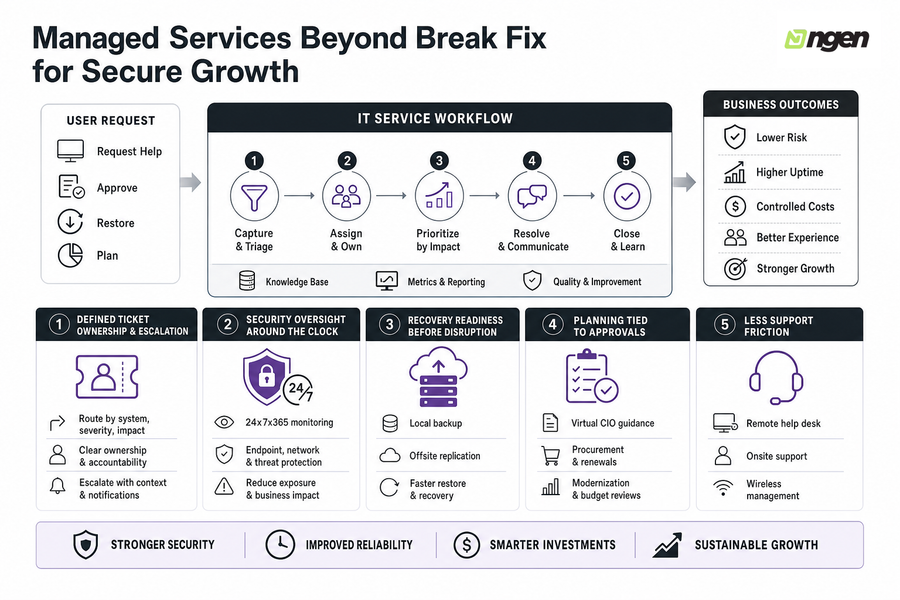
Managed services create value when monitoring, help desk support, cybersecurity, backup, procurement, and advisory planning are tied to daily workflows. Since our evolution from MSP to MSSP, our service plans are built to reduce unmanaged risk while improving how people request, approve, restore, and plan IT services.
-
Defined ticket ownership and escalation: Service desk queues route issues by system, severity, and business impact. Users know where a payroll access ticket stands and when escalation begins.
-
Security oversight around the clock: 24x7x365 monitoring and essential cybersecurity tools help reduce exposure across endpoints and networks. The business stake is clear when 63% of organizations said they would increase prices after a breach.
-
Recovery readiness before disruption: Local backup and offsite replication support faster decisions when files, servers, or cloud data need restoration.
-
Planning tied to approvals: Virtual CIO guidance connects renewals, procurement, modernization, and budget reviews.
-
Reduced support friction: Remote help desk, onsite support, and wireless management reduce repeat tickets by giving users clearer support paths.
Plan Your Managed Services Shift
-
What Are Managed IT Services? A Practical Guide To IT Accountability
-
Why Managed Services Now Defines Secure, Efficient IT Operations
-
Managed IT Services Pricing: What Budget Owners Need To Know
-
How To Choose Managed Services Provider For Continuity And Security
-
IT Managed Services Challenges That Signal Business Growth Risk
Choosing Managed Service Over Break Fix Support
Changing support models affects budgets, vendors, internal expectations, and user habits. It also gives you a chance to replace scattered break fix services with a disciplined review process tied to continuity, risk controls, and service planning. Our ITIL-aligned approach starts with evidence, then connects the service model to the work people need to complete every day.
-
Review recent ticket history: Sort the last 90 days by system, location, severity, repeat issue, and affected team.
-
Map critical workflows: Document payroll, customer service, approvals, invoicing, cloud access, and VoIP dependencies.
-
Validate recovery details: Confirm backup status, replication frequency, recovery roles, escalation contacts, and priority file locations.
-
Compare service plan fit: Match options to help desk demand, security exposure, onsite needs, wireless coverage, and modernization projects.
Move Beyond Break Fix IT
Turn reactive repair tickets into monitored, secure operations with NGEN LLC. Start planning a managed services model built for continuity.
From Break Fix IT To Managed Service Readiness
A support model change works best when the environment is visible before the service plan is finalized. Gaps in asset records, vendor contacts, cloud access, or recovery steps turn onboarding into cleanup.
Centralized infrastructure management, COOP planning, cybersecurity and information assurance, cloud services, data center modernization, and Technology Business Management become practical when tied to systems, owners, and service decisions.
-
Asset and endpoint visibility: Build a current view of servers, networks, users, cloud applications, endpoints, and wireless environments.
-
Documentation that supports action: Keep access controls, vendors, support contacts, recovery steps, and change approvals where teams can use them during a ticket.
-
Executive visibility into priorities: Review recurring issues, cybersecurity priorities, COOP needs, and modernization projects through service reports that support budget decisions.
A Practical Path To Stronger IT Support
Moving from reactive repair to a managed operating model improves uptime, support coverage, cybersecurity oversight, backup readiness, and planning discipline across tickets, devices, recovery workflows, and service planning. It also addresses early warning signs such as stalled approvals, VoIP interruptions, wireless ticket spikes, and backup gaps. Let’s make it practical.
At NGEN LLC, we support organizations with Professional Services IT, Fully Managed IT Services, MSSP capabilities, virtual CIO guidance, 24x7x365 monitoring, remote and onsite support, cybersecurity tools, backups, replication, and wireless management; contact us to discuss your current service model and how Information, Technology, and You can work more seamlessly together.