



Table of Contents
-
Why Managed Services Matters When IT Demand Outpaces Internal Capacity
-
IT Managed Services Value Proposition For Budgets, Risk, And User Experience
-
Why Managed IT Services Are Better For Security, Continuity, And Resilience
-
Why Use Managed IT Services To Modernize Infrastructure Without Disrupting Operations
-
Why Managed IT Services Require Clear Provider Evaluation Criteria
-
Why Managed Services Providers Should Support The Business Roadmap
IT teams are being asked to clear tickets, secure data, guide cloud choices, support remote users, and prove continuity readiness while protecting uptime, budgets, user satisfaction, and risk posture. The executive question behind why managed services is no longer only cost. It is operating maturity.
Ancha Jordan, Director of Account Management at NGEN LLC, notes: “Managed IT works best when every alert, ticket, backup check, and leadership update follows a defined path before users feel the impact.”
That maturity shows up in monitoring alerts that route correctly, tickets with clear owners, backup checks that are documented, approvals that move, and risk updates leadership can use. We view managed IT and MSSP support through that operating lens.
Why Managed Services Matters When IT Demand Outpaces Internal Capacity
The managed services importance becomes clear when internal teams must support users, monitor systems, secure data, modernize infrastructure, and advise leadership at the same time. That pressure explains why managed services are a strategic focus for 99 percent of organizations.
-
Ticket queues stay visible: Help desk triage separates a locked account from a finance system outage and reduces unresolved issues that slow invoices, approvals, or customer handoffs.
-
Monitoring becomes continuous: 24x7x365 monitoring routes server, endpoint, and wireless alerts before an outage becomes the first signal that something failed.
-
Security work becomes routine: Cybersecurity controls, patching, and information assurance tasks receive scheduled follow-through, especially when 60% cite cybersecurity as the top MSP driver.
-
Planning gains structure: Virtual CIO guidance connects budgets, approvals, refresh cycles, procurement timing, and IT-business alignment.
The next step is matching demand to disciplined service capabilities that protect reliability, scalability, continuity, and mission-critical operations.
Service desk operations, cybersecurity monitoring, cloud planning, backup and replication.
IT Managed Services Value Proposition For Budgets, Risk, And User Experience
The IT managed services value proposition is a service model that connects tickets, monitoring, cybersecurity, procurement, cloud decisions, and executive planning. That is one reason about 55% of companies seek value-added services and reduced security risk.
-
More predictable IT spending: Service plans support budget reviews, approvals, invoice clarity, and fewer surprise projects after hardware failures or unplanned renewals.
-
Faster support for users: Remote help desk coverage, onsite escalation, and ticket ownership show users who is fixing the issue and when work can resume.
-
Stronger security follow-through: MSSP capabilities make patching, alerts, control reviews, and documentation part of the operating calendar.
-
Better infrastructure decisions: Data center modernization, network services, cloud migrations, and system integration move through documented planning, with dependencies and downtime windows visible.
-
Cleaner executive visibility: ITIL-aligned reporting, supported by ISO 9001:2015, ISO 27001, and ISO 20000-1 discipline, connects incidents, risks, invoices, and roadmap decisions.
The next decision is which work stays internal and which work benefits from managed support.
Why Managed IT Services Are Better For Security, Continuity, And Resilience
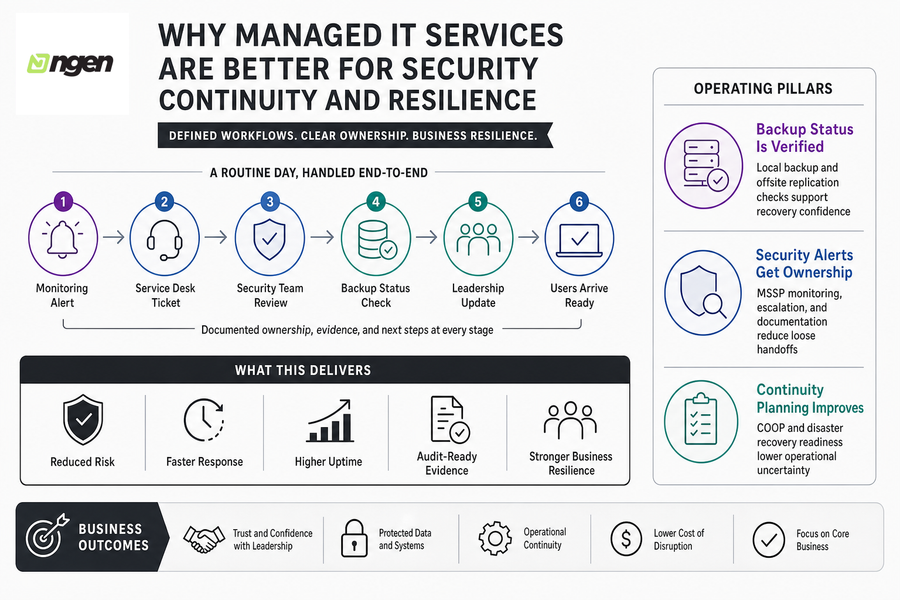
A routine day can include a password reset, a failed backup alert, a wireless access issue, a suspicious login, and an executive asking whether COOP materials are current. These items touch different systems, but they affect the same business day.
That is why managed IT services are better when issues follow defined workflows instead of one-off reactions. Our move from MSP to MSSP in 2018 reflects that operating need, as 44% of businesses seek MSPs for cybersecurity capabilities.
An overnight monitoring alert opens a service desk ticket. The security team reviews the event, backup status is checked, and leadership receives a concise update before users arrive and before business operations are affected.
Resilience improves when certified professionals document ownership, evidence, escalation steps, and next actions.
-
Backup status is verified: Local backup and offsite replication checks support recovery confidence before a recovery request becomes urgent.
-
Security alerts get ownership: MSSP monitoring, escalation, and documentation reduce loose handoffs and create a record of what happened, who reviewed it, and what changed.
-
Continuity planning improves: COOP and disaster recovery readiness lower uncertainty by giving leadership clearer expectations for systems, files, users, and recovery priorities.
Explore Managed IT Essentials
Why Use Managed IT Services To Modernize Infrastructure Without Disrupting Operations
Modernization fails when teams treat it as a side project instead of an operating plan. That is why use managed IT services is a practical question when cloud migrations, virtual operating systems, data center management, wireless upgrades, VoIP, and network changes affect tickets, vendors, approvals, and downtime windows.
Modernization needs technical sequencing and business communication. A firewall change, sensor deployment, or wireless refresh can affect endpoints, applications, access rules, and help desk scripts, and 43% say cybersecurity is their biggest challenge in IoT deployment.
-
Map current dependencies: Document servers, applications, users, network connections, vendor touchpoints, and support requirements before scheduling changes.
-
Sequence low-disruption changes: Use maintenance windows, testing, rollback plans, and approvals to protect operations during migrations, upgrades, and cutovers.
-
Align invoices with priorities: TBM and procurement visibility connect spend to budget decisions, renewal timing, and business value.
-
Support users after rollout: Help desk scripts, training notes, onsite support, and satisfaction follow-up close the loop after new systems, phones, wireless access, or cloud services go live.
Provider evaluation should test whether these workflows are standard practice, not special handling.
Network services, cloud services, data center modernization, VoIP support.
Strengthen IT Operations With NGEN LLC
See how managed IT services can help your team improve security, uptime, support, and operational maturity.
Why Managed IT Services Require Clear Provider Evaluation Criteria
Choosing a provider is an operating decision, not only a sourcing decision. The wrong fit explains why managed IT services disappoint: vague ticket ownership, slow escalations, unclear invoices, inconsistent security tasks, and weak executive reporting.
Change is not easy. Teams worry about control, institutional knowledge, and whether service quality will hold up during month-end close, a board report, or a field office outage. Evaluation criteria should make those concerns measurable.
-
Review current ticket data: Identify recurring issues, aging tickets, response gaps, handoff delays, and user satisfaction patterns.
-
Define escalation rules: Clarify remote help desk, onsite support, security incidents, vendor coordination, and leadership notifications.
-
Confirm monitoring coverage: Validate 24x7x365 monitoring scope, alert routing, escalation paths, and documentation expectations.
-
Test reporting quality: Ask for service reports connecting incidents, risks, invoices, project status, and roadmap priorities.
-
Assess security maturity: Review cybersecurity controls, backup practices, replication, information assurance alignment, and evidence of follow-through.
Look for documented processes, certified IT professionals, MSSP capability, and enough team depth to support daily operations and planning. For us, that means an ITIL-aligned service delivery approach, more than 50 employees, and operating discipline supported by ISO 9001:2015, ISO 27001, and ISO 20000-1 certifications.
Why Managed Services Providers Should Support The Business Roadmap
The best reason to use managed IT is practical: daily support improves, cybersecurity tasks become repeatable, modernization is easier to govern, and leadership gains clearer visibility into risk, cost, and readiness. That is why managed services providers should be measured by how well they support the business roadmap, not only by how many tools they manage.
If a failed backup alert, wireless outage, ticket backlog, or continuity question is forcing reactive work, contact NGEN LLC for a practical discussion. We support government and private sector organizations with fully managed IT services, MSSP capabilities, service desk operations, onsite support, strategic IT planning, and infrastructure management.
As a 100% minority-owned Small Business and certified MBE with more than 34 years of experience, more than 50 employees, and ISO 9001:2015, ISO 27001, and ISO 20000-1 certifications, we help make Information, Technology, and You work together with less operational friction.