



Table of Contents
Service desk tickets, cloud migrations, endpoint security, audits, invoices, and access approvals often compete for the same staff and budget. At NGEN LLC, we see managed services vs professional services as an operating model decision tied to cost control, continuity, cybersecurity, and maturity.
Through our “Information, Technology, and You” perspective, service clarity helps people, systems, and processes work together while mission-critical IT runs securely, smoothly, effectively, and efficiently. Cybersecurity adds pressure: 60% of respondents said it was the top challenge leading them to an MSP.
Ancha Jordan, Director of Account Management at NGEN LLC, notes: “Service model clarity gives teams a practical way to route work, fund priorities, protect systems, and keep daily operations moving during change.”
Managed Services Vs Professional Services In IT Operating Models
Clear service boundaries matter before anyone assigns tickets, approves budgets, or measures provider performance. Without them, a help desk queue absorbs project work, a migration lacks support ownership, and an invoice becomes difficult to match to the work performed.
We help clients define which workflows belong in ongoing managed support and which require scoped professional work, using our native services and top-tier partners where tailored delivery improves the operating plan.
-
Recurring support ownership: Managed IT services cover subscription-based remote and proactive management, including help desk queues, patching, monitoring, endpoint support, user administration, managed network solutions, and routine infrastructure maintenance.
-
Project delivery focus: Professional Services IT Services address cloud migrations, systems and software integration, data center modernization, IT procurement, technical documentation, VoIP implementations, and security assessments.
-
Different approval paths: Ongoing support follows service agreements and recurring invoices, while scoped projects use statements of work, budget approvals, change orders, and acceptance criteria.
-
Different success measures: Managed services track response times, uptime, and ticket resolution, while professional work is measured by milestones, deliverables, documentation quality, and handoff readiness.
Managed Services And Professional Services For Daily IT Control
Daily IT control depends on knowing which team owns each user, asset, endpoint, network, ticket, and approval. Our ITIL-aligned service delivery approach supports repeatable workflows for IT Operations and Maintenance, Network Services, Cybersecurity and Information Assurance, Cloud Services, and centralized infrastructure management.
A password reset, firewall alert, laptop replacement, and access approval can each follow a defined queue, escalation path, and control check instead of relying on informal handoffs.
A public-facing agency preparing for a cloud migration still needs service desk coverage while project engineers move applications and data. Users submit password reset tickets, endpoint monitoring flags missing patches, network teams watch VPN stability, and managers approve access changes in the identity system. Professional services manage the migration plan, cutover schedule, and documentation, while managed services keep daily operations steady.
That clarity turns coordination into measurable business impact across service desk operations, cybersecurity monitoring, cloud migration planning, and asset lifecycle management.
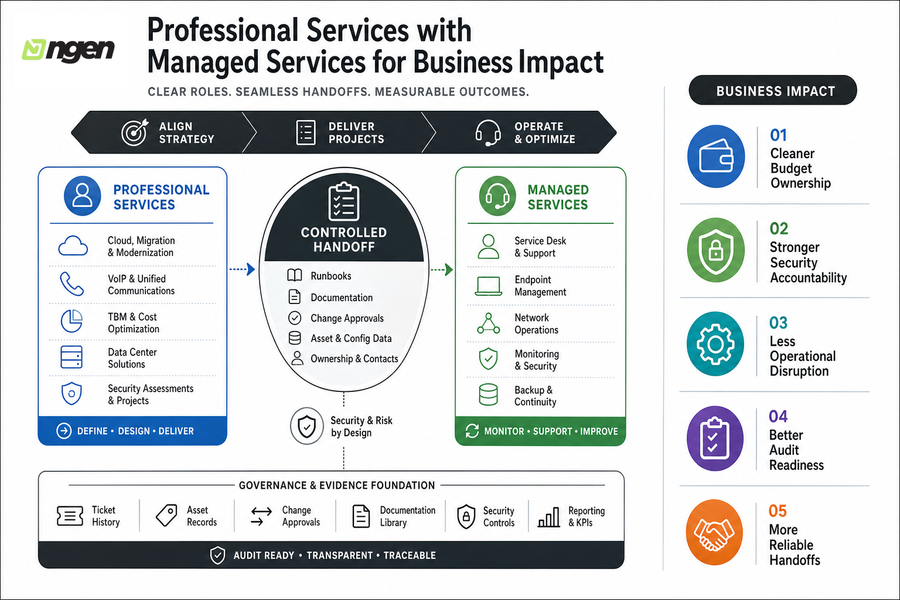
Professional Services With Managed Services For Measurable Business Impact
When service models are misaligned, project teams get pulled into tickets, service desks inherit incomplete deployments, invoices become hard to reconcile, and security ownership becomes unclear. This matters as professional and scientific services represent around 18% of impacted sectors in one recent analysis, while another reported that attacks against Professional Services, at 100 notices, more than doubled in the quarter.
-
Cleaner budget ownership: Subscription charges stay tied to managed IT coverage, while scoped project costs align to migrations, VoIP, TBM, or data center work. Finance can reconcile invoices against approvals, service reports, milestones, and accepted deliverables.
-
Stronger security accountability: We moved from MSP to MSSP to meet rising security demands, using integrated cybersecurity tools aligned with industry standards. Monitoring and assessments support different but connected risk decisions, from alert response to remediation planning.
-
Less operational disruption: Professional services handle cloud, COOP, and modernization work while managed services keep service desk, endpoint, and network workflows stable. Users continue to receive support while engineers manage cutovers, testing, and rollback planning.
-
Better audit readiness: Ticket history, asset records, change approvals, documentation, and security controls become reviewable evidence for compliance reviews, internal audits, and leadership decisions.
-
More reliable handoffs: Runbooks, escalation paths, user notices, and ownership records move project deliverables into steady-state support. The service desk knows what changed, which systems are in scope, and which team owns the next ticket.
Explore Managed Services Planning
-
What Are Managed IT Services? A Practical Guide To IT Accountability
-
Why Managed Services Now Defines Secure, Efficient IT Operations
-
How To Choose Managed Services Provider For Continuity And Security
-
Managed IT Services Pricing: What Budget Owners Need To Know
-
IT Managed Services Challenges That Signal Business Growth Risk
Managed Services And Professional Services Decision Points For Leaders
Changing service models affects people, budgets, vendor relationships, ticket routing, and internal approvals. A sound decision starts by mapping the work, who owns it, what risk it carries, and what outcome the organization expects, especially where uptime, procurement steps, reliability, security, and stakeholder approvals shape the operating plan.
-
Map recurring tickets, alerts, access requests, patch windows, and maintenance tasks before assigning managed support.
-
Separate one-time projects such as cloud migrations, system integrations, security assessments, IT procurement, and technical documentation into scoped professional work.
-
Identify systems needing continuous coverage, including servers, networks, endpoints, cloud platforms, phones, and security tools.
-
Define handoff requirements before kickoff, including runbooks, user communications, asset updates, support queues, and escalation paths.
-
Review invoices, service reports, and Technology Business Management data to confirm spend matches service ownership and business outcomes.
Clarify Your IT Service Model
Reduce handoff gaps between daily support and project work. Connect with NGEN LLC to plan the right mix of managed and professional services.
Managed And Professional Services Planning With NGEN LLC
Organizations run IT more smoothly when recurring operations, cybersecurity, cloud work, data center needs, COOP planning, VoIP, TBM, and project-based IT work have clear ownership, documented workflows, and measurable outcomes tied to tickets, assets, users, approvals, budgets, and risk decisions.
At NGEN LLC, we combine managed IT, MSSP capabilities, professional services, native capabilities, and top-tier partner solutions tailored to each client’s business model, with support for more than 100 organizations nationwide.
If your teams are balancing daily tickets with a cloud migration, audit deadline, security assessment, or infrastructure refresh, contact NGEN LLC to assess the right service model and build a practical plan for your users, systems, budget, and risk decisions.