



Table of Contents
An IT director is short two team members, a cloud migration deadline is close, security remediation is unfinished, and aging help desk tickets are slowing department workflows. Leadership needs a capacity decision, not another status meeting.
Ancha Jordan, Director of Account Management at NGEN LLC, notes: “Capacity decisions work best when leaders map each support gap to ownership, service levels, security oversight, and the operational reports needed for confident decisions.”
The choice between staff augmentation vs managed services matters because both models add IT capacity, but they assign accountability differently. In managed services vs staff augmentation discussions, we focus on who directs the work, who reports progress, and who owns service outcomes where uptime, security, reliability, and user support carry daily business consequences.
Staff Augmentation Vs Managed Services For IT Capacity Decisions
Capacity decisions surface fast: servers need patching, users wait on password resets, procurement needs laptop approvals, and a cloud cutover date does not move. The right model protects ticket flow, project timelines, and leadership confidence.
-
Added technical hands: Staff augmentation brings contract IT professionals into your workflow, under your direction.
-
Defined service responsibility: Managed IT services assign duties through SLAs, reporting, escalation paths, and operating procedures. ISO/IEC 20000-1 defines requirements for establishing, maintaining, and continually improving a service management system.
-
Best for targeted gaps: Augmentation fits short-term projects, niche skills, and teams with internal managers who can review work.
-
Best for ongoing operations: Managed services fit service desk support, security monitoring, infrastructure care, continuity planning, and executive reporting.
At NGEN LLC, we often bring a full ITIL-aligned team, not only one resource, so capacity connects to documentation and continuity.
Managed Services Vs Staff Augmentation In Daily Operations
The best model depends on who has the time, authority, and tools to manage work after capacity is added. That distinction matters when 24% of cybersecurity departments faced layoffs and 67% said they lacked staff to meet goals.
|
Area |
Staff augmentation |
Managed services |
|---|---|---|
|
Who manages the work |
Internal IT lead assigns tasks |
Provider manages agreed scope |
|
Who owns outcomes |
Internal leadership |
Provider against SLAs |
|
Coverage model |
Named resources |
Team-based coverage |
|
Security and monitoring |
Client-directed tools |
24×7 monitoring and response |
|
Knowledge retention |
Must be captured internally |
Built into process documentation |
|
Cost structure |
Labor-based |
Recurring service model |
|
Best fit |
Project or skill gap |
Ongoing operations |
Augmentation gives leaders direct control over tasks and project handoffs. Managed services give leaders defined accountability through SLAs, service reviews, documented processes, security-focused management, and executive visibility.
How IT Staff Augmentation And Managed Services Affect Cost Control
Labor cost is broader than hourly pay. Private industry compensation averaged $46.89 per hour, including $32.82 in wages and $14.07 in benefits, while CyberSeek counted 514,359 U.S. cybersecurity job listings and a 74% supply-demand ratio. ISC2 also reported 95% of security teams have at least one skills gap.
-
Augmentation cost factors: Include onboarding, manager time, tool access, security reviews, and knowledge transfer.
-
Managed service predictability: Defined scope, recurring reports, and shared processes connect invoices to service desk, cybersecurity, and IT operations outcomes.
-
Security staffing risk: KPMG reported 53 percent cited candidate shortages as high impact, while IBM found understaffed security teams saw $1.76 million in higher breach costs. IBM also reported a 26% increase in severe staffing shortages, with high-shortage organizations averaging $5.74 million in breach costs versus $3.98 million for low or no shortages.
Cost control improves when capacity planning includes risk exposure, service reporting, and continuity requirements. Our ITIL-aligned model connects managed IT services, cybersecurity, IT operations, and service desk reporting to the planning discipline leaders need before budgets and risk reviews come due.
Explore Managed Services Models
-
Break Fix Vs Managed Services: From Repair Tickets To Operational Control
-
Managed Services Vs Professional Services: Plan IT Work Without Handoff Gaps
-
How To Choose Managed Services Provider For Continuity And Security
-
Why Managed Services Now Defines Secure, Efficient IT Operations
-
IT Managed Services Challenges That Signal Business Growth Risk
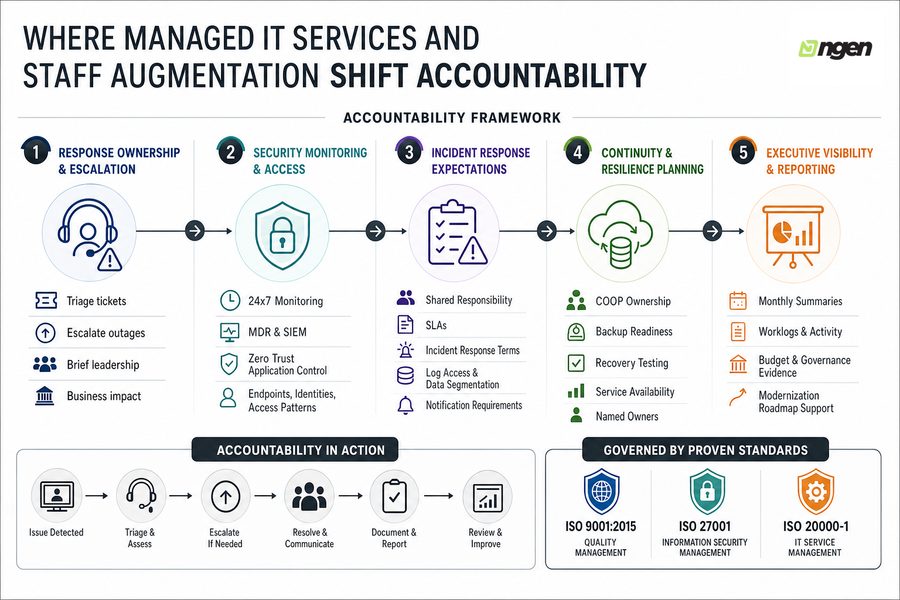
Where Managed IT Services And Staff Augmentation Shift Accountability
Accountability determines how IT supports customers, compliance, approvals, invoices, and continuity when service issues occur.
-
Response ownership and escalation: Decide who triages tickets, escalates outages, and briefs leadership when a finance system login issue blocks invoice approvals.
-
Security monitoring and access: 24×7 monitoring, MDR, SIEM, and Zero Trust application control reduce exposure by watching endpoints, identities, and unusual access patterns.
-
Incident response expectations: CISA’s MSP and MSSP guidance calls for shared responsibility, SLAs, incident response terms, log access, data segmentation, and notification requirements.
-
Continuity and resilience planning: COOP, backup readiness, recovery testing, and service availability need named owners before a file share or hosted application fails.
-
Executive visibility and reporting: Monthly summaries and worklogs turn service activity into budget, governance, and modernization evidence. Our integrated ISO 9001:2015, ISO 27001, and ISO 20000-1 framework supports that discipline.
Choose the Right IT Support Model
Clarify whether staff augmentation or managed services fits your capacity gaps, accountability needs, and service goals with NGEN LLC.
Choosing Between Staff Augmentation And Managed IT Services
Staffing, procurement, budgets, security requirements, and user expectations rarely move on the same timeline. Use this checklist when a ticket backlog, audit deadline, migration plan, or after-hours support gap forces a capacity decision:
-
Choose augmentation when there is a defined short-term project, one clear skill gap, and an internal IT leader who can direct the work.
-
Choose managed services when ongoing support, security operations, infrastructure monitoring, service desk performance, and SLA reporting are required.
-
Combine both when a managed foundation exists, but a migration, documentation initiative, VoIP rollout, or data center modernization needs temporary specialists.
-
Reassess the model when ticket volume, cyber risk, after-hours support, compliance pressure, or leadership reporting increases.
We support help desk operations, cybersecurity, cloud migration, network engineering, and managed infrastructure services through an ITIL-aligned delivery model built for secure, reliable daily operations.
Talk Through The Right IT Support Model With NGEN LLC
Staff augmentation adds people for targeted needs, while managed services add ongoing accountability through defined responsibilities, reporting, security monitoring, and SLAs.
NGEN LLC is a 100% minority-owned Small Business and certified MBE serving government and private sector clients nationwide, with more than 34 years of experience and integrated certifications including ISO 9001:2015, ISO 27001, and ISO 20000-1.
If you need to stabilize aging help desk tickets, secure servers and end-user devices, or plan a cloud, network, or data center modernization project, request our free network assessment or talk with us about the model that fits your organization. We make our clients feel like they’re our only client.